A CPI(ML) Liberation fact-finding team has raised serious questions over the killing of three men in a police encounter at Sherpur village in Maner block of Patna district, Bihar. Following a visit to the site and the homes of the deceased on 8 November, the team termed the encounter fake and demanded an independent judicial inquiry. The investigation revealed major contradictions in the police account, including discrepancies in the number of bullets fired, the injuries sustained by the deceased and the absence of credible evidence of a gunfight at the reported encounter site.
The three deceased were identified as JP Yadav (42) of Tarachak, Danapur; Bablu Yadav (38), who lived in the Agricultural Farm area of Danapur and was originally from Suarmarwa village in Maner; and Raja Sharma (20) of Ganghar village, Danapur.
The team first visited the residence of Bablu Yadav in the Agricultural Farm area of Danapur. The house was locked, and neighbouring residents appeared frightened. They informed the team that Bablu had returned home around 4 pm on 5 November after arranging medical treatment for his mother, who had suffered a fractured hand. He later left for the market. Local residents maintained that he was not involved in any unlawful activities.
The team subsequently visited the family of JP Yadav in Tarachak. His elder brother, Ramashish Yadav, explained that JP had been staying with his sister in Ramgarh, Jharkhand, following the registration of a police case against him in June over a dispute involving children in the neighbourhood.
JP had left Ramgarh by bus on 5 November to return to Danapur, where he was scheduled to seek bail in court on 7 November. He had informed his family that he would reach home by 10 pm. When his phone became unreachable that night, the family assumed he had stopped somewhere along the way. The following morning, the family learnt through Facebook that JP had been killed in a police encounter.
When family members reached Danapur Sadar Hospital, they found a heavy police presence. According to their testimony, police prevented them from approaching the ambulances parked behind the hospital and resorted to a lathi charge when they attempted to see the body.
After considerable difficulty, the family was finally able to see JP's body. They reported finding seven bullet wounds on his chest, although the T-shirt he was wearing had no bullet holes. The family also informed the team that JP's in-laws lived in Ganghar village, where Raja Sharma also resided. Ganghar is located across the Ganga river, directly opposite Sherpur..
Villagers Deny Any Gunfight at the Encounter Site
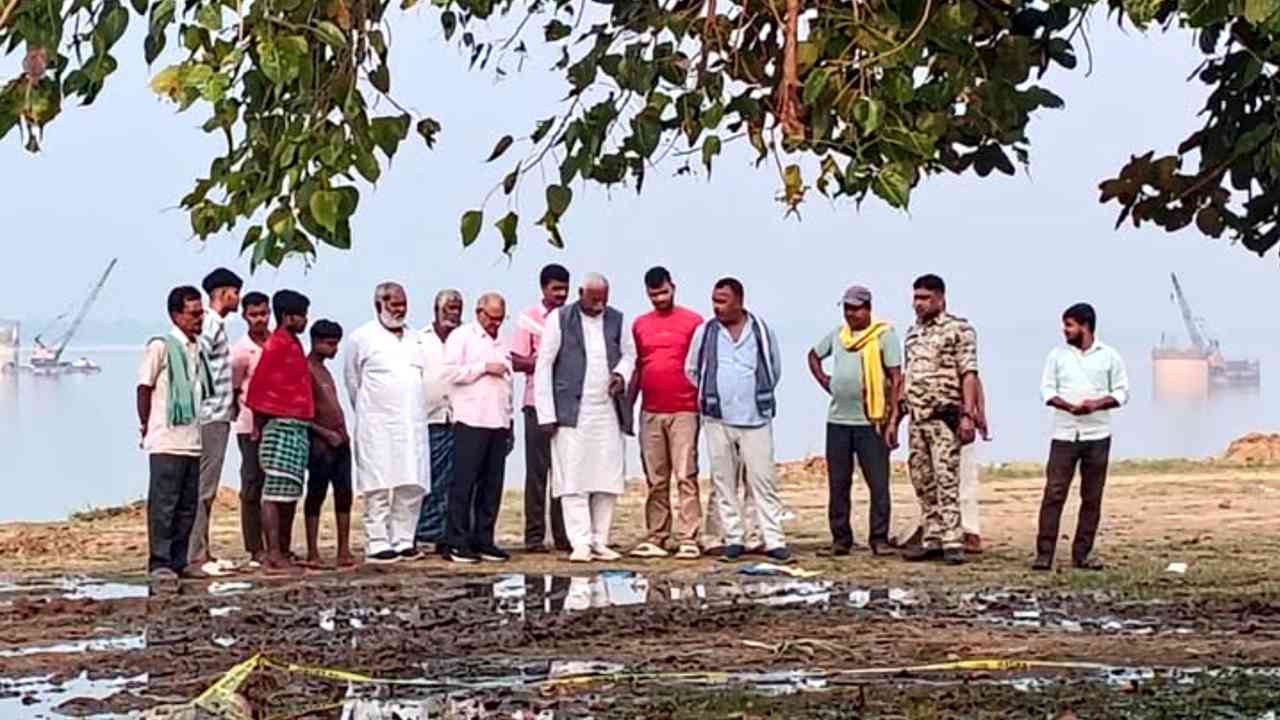
The fact-finding team inspected the reported encounter site near a temple on the banks of the Ganga, approximately one kilometre west of Sherpur village. Local residents and the temple priest told the team that no encounter had taken place at the location. The priest stated that he had heard no gunshots during the night. When he woke around 5 am, a large police contingent was already present and an ambulance was leaving the area.
Villagers explained that during the Hindu calendar month of Kartik, women begin arriving at the riverbank for ritual bathing as early as 3 am. However, residents were reluctant to speak openly about the incident because of fear of the police. Several villagers expressed concern that police presence had increasingly become a source of fear rather than security.
During its inspection, the team found bloodstains at three separate locations approximately 100 yards south of the temple and 20 to 25 feet east of the river water. Gloves and a torn piece of a gamchha, a traditional cotton towel, were also found nearby.
According to the team, the cloth appeared to be part of the same gamchha shown tied around a police officer's arm in the police account of the incident. A high mound of earth associated with a brick kiln was situated approximately ten metres east of the bloodstains.
The team observed that the physical features of the location did not support the police description of the gunfight and called for an independent investigation into where and under what circumstances the three men were actually shot.
One of the most serious contradictions identified by the team concerned the number of bullets fired during the encounter. According to the police version reported in the Hindi newspaper Prabhat Khabar on 8 November, police personnel fired 18 rounds, while the three men fired 24 rounds.
However, information gathered by the team indicated that the three deceased had sustained approximately 30 bullet injuries between them. The teams questioned how the three men could have suffered nearly 30 bullet wounds when the police claimed to have fired only 18 rounds. Even if every police bullet had struck the deceased, the official account would still leave several injuries unexplained. The team also questioned why the bullet wounds were concentrated primarily on the chests of the three men, raising doubts about the circumstances of the shooting and whether the injuries were consistent with the police description of an exchange of fire.
Further questions emerged from a video statement by the Superintendent of Police, who claimed that a bullet fired by the men had grazed the uniform of the Maner Station House Officer, narrowly missing him. The team questioned why a gamchha had been tied around the officer's arm if the bullet had merely grazed his uniform. The cloth was reportedly identified as belonging to JP Yadav. The fact-finding team also asked why the gamchha showed no visible bloodstains, why the officer had not required hospital treatment and why he was subsequently seen performing his duties normally.
Based on testimonies from the families and local residents, physical evidence observed at the location and contradictions in the police version, the CPI(ML) fact-finding team concluded that there were strong grounds to believe that the encounter had been staged.
The team stated that the available circumstantial evidence suggested that the three men may have been killed elsewhere before the scene was arranged at Sherpur to give the appearance of a police encounter.
The teams also observed signs that water had been pumped onto the ground at the site, making bloodstains difficult to identify. Local residents raised questions about the incident based on the blood found at the location and videos released by the police.
CPI(ML) said that the personal backgrounds of the deceased and any criminal cases registered against them were separate matters to be addressed through the legal process. Regardless of the accusations against an individual, the police have no authority to execute anyone outside the law.
The Party warned that when the police, entrusted with maintaining law and order, themselves act outside the law, it constitutes a grave threat to democratic rights, civil liberties and the rule of law.
CPI(ML) Liberation demanded an independent, high-level judicial inquiry into the killing of the three men at Sherpur. The Party called for a comprehensive forensic examination of the encounter site.. It further demanded that video recordings of the post-mortem examinations, ballistic reports and detailed medical findings concerning the bullet injuries sustained by the deceased be made public.
The Party demanded an impartial investigation into the role of police officers involved in the incident and called for officers under suspicion to be kept away from the investigation to prevent interference with evidence and witnesses. It also demanded adequate compensation and protection for the families of the deceased. Terming the incident a serious violation of human rights, CPI(ML) called for the identification of those responsible and strict legal action against them.
The Party asserted that the police uniform cannot become a licence to kill. No police officer can be allowed to place themselves above the law, and the growing threat of extrajudicial killings must be firmly resisted in defence of democratic rights and the rule of law.
The fact-finding team included CPI(ML) Polit Bureau member and Patna District Secretary Comrade Amar, former MLA and All India Agricultural and Rural Labour Association (AIARLA) National President Satyadev Ram, former MLA and All India Kisan Mahasabha (AIKM) Bihar State President Rambali Singh Yadav, Maner Block Secretary Sudhir Kumar, peasant leader Ramkumar Yadav and Upendra Yadav.